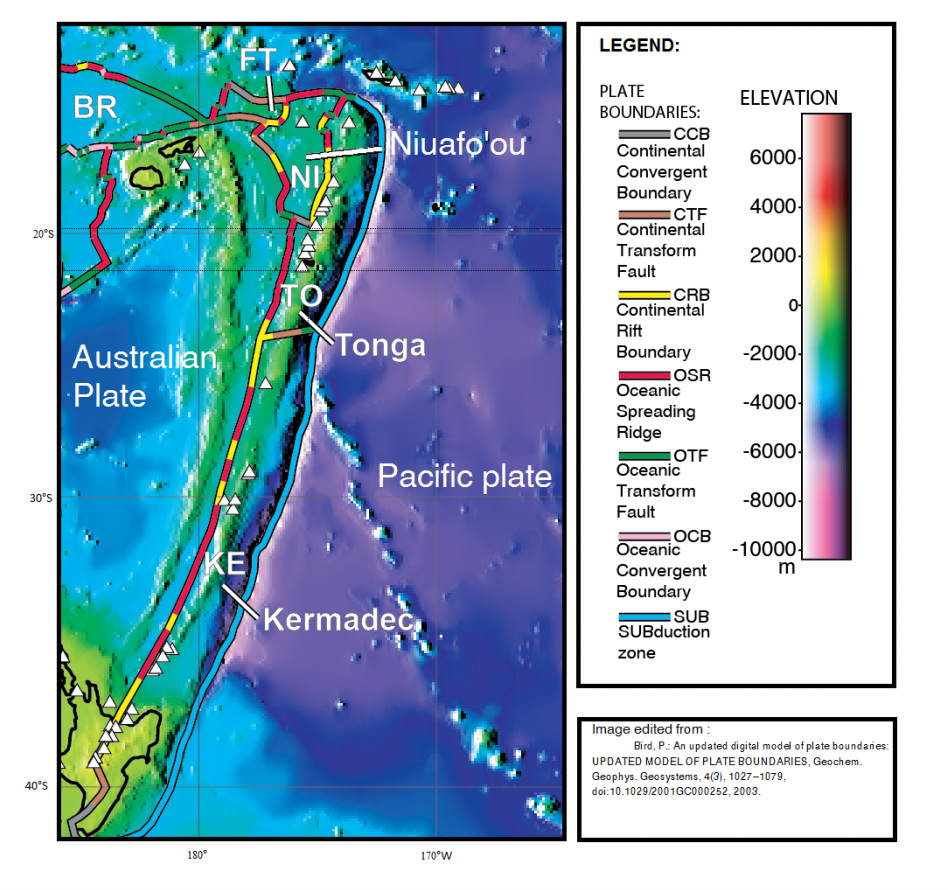
The Tonga-Kermadec Trench sits on the eastern boundary of the Australian Plate, where it meets the Pacific Plate. The trench is visible as the deep, dark-blue strip running roughly north to south. Map adapted from Bird (2003).
Move east. About 2,500 km from the Sunda Trench, on the other side of Australia, lies another plate boundary, the Tonga-Kermadec TrenchA 2,500-km-long deep-sea trench running between New Zealand and Samoa, marking where the Pacific Plate dives under the Australian Plate. One of the deepest trenches on Earth.. Here the Pacific PlateThe largest tectonic plate on Earth, covering most of the Pacific Ocean basin. Composed entirely of oceanic crust. meets the Australian PlateThe plate Australia sits on. Its eastern edge is oceanic crust, which is what meets the Pacific Plate at Tonga.. You already know how to think about plate boundaries from Case 1, apply it here.
The situation at the Tonga-Kermadec Trench
Now apply what you know.
Here's what's true at this specific boundary:
→
Two plates meet here. The Pacific Plate (east) and the Australian Plate (west). Both are made of oceanic crustThe crust under the ocean. Made of denser rock (basalt). Thinner than continental crust but heavier per cubic metre., this is an ocean-ocean boundary.
⇅
They're different ages. The Pacific Plate's leading edge is around 100 million years old, the Australian Plate's eastern edge is much younger. Older oceanic crust is colder and denser than younger oceanic crust, so the Pacific Plate's leading edge is the heavier one.
↑
They're moving toward each other fast. The Pacific Plate converges westward at roughly 24 cm/yr, one of the fastest plate convergence rates anywhere on Earth, more than three times the speed at the Sunda Trench.
Take a moment. With what you now know about plates, mantle, and how plates can meet, what do you reckon happens here?
Step 1: Predict
What do you think will happen at this boundary?
Try starting: "I think this because…"
Choose an option above and write at least 5 characters of reasoning.
What a scientist would predict
You predictedYour reasoning
The Tonga-Kermadec Trench is a convergent boundary, so the prediction is that one plate slides under the other. Both plates here are oceanic, so density is decided by age: the Pacific Plate is older, colder, and denser than the Australian Plate at this boundary, so the Pacific Plate sinks beneath the Australian Plate. As it descends, water trapped in the subducting slab triggers melting in the mantle wedge above, and the resulting magma rises to build a chain of volcanic islands (the Tongan archipelago, including Hunga Tonga). Tonga is one of the fastest-converging subduction zones on Earth, at around 240 mm per year.
If you picked "plates slide past each other sideways": that is correct for the Alpine Fault (Case 3) but not here. At Tonga, the Pacific Plate is being shoved down into the mantle at one of the fastest rates anywhere on Earth. The trench, the deep earthquakes, and the chain of volcanic islands above are all signatures of subduction, not strike-slip.
If you picked "plates pull apart and new crust forms": that is correct for the Southeast Indian Ridge (Case 4) but not here. At Tonga the plates are converging, not pulling apart. The volcanic islands you see are not formed by mantle rising at a spreading centre, but by water-driven melting above a sinking plate. The signature feature at the surface is a deep trench, not an underwater ridge.
Predictions are not graded. The point was to commit to a guess before watching the animation, so that what you see next has something to push against.
Step 2: Observe
Watch what actually happens.
Time scale: 0 to ~50 million years compressed into 9 seconds
Both plates are oceanic here, so density is decided by age. The Pacific Plate's leading edge is much older and colder, which makes it denser, so it sinks beneath the younger Australian Plate edge. As it descends, water from the subducting plate triggers melting in the wedge of mantle above. That magma rises through the overriding oceanic plate, building a chain of submarine volcanoes that grow tall enough to break the ocean surface as islands. The Tongan archipelago is exactly this: a volcanic arc built on a subduction zone.
Step 3: Explain
Now make sense of what you saw.
Try starting: "My prediction was… What I actually saw was… This means that…"
Write at least 15 characters to enable Submit (0/15).
Here's one way to explain this
Your explanation
At the Tonga-Kermadec Trench, two oceanic plates meet. The Pacific Plate is older (and therefore colder and denser) than the Australian Plate at this boundary, so it sinks beneath the Australian Plate and descends into the mantle. As the slab sinks, water trapped in it lowers the melting point of the mantle wedge above, producing magma. That magma rises through the overriding plate and erupts on the seafloor, building submarine volcanoes that grow tall enough to break the surface as a chain of islands (the Tongan archipelago, which includes Hunga Tonga). Tonga is one of the fastest-converging subduction zones on Earth, at around 240 mm per year. The Hunga Tonga-Hunga Ha'apai eruption in January 2022 was a direct result of this slab-driven melting.
What makes a strong answer here:
Identifies the boundary as convergent (specifically oceanic-oceanic subduction): one plate slides under the other.
States which plate sinks, and why: the Pacific Plate is older and denser, so the Pacific Plate sinks beneath the Australian Plate.
Explains the mechanism for volcanic islands: water from the subducting slab triggers melting in the mantle wedge, magma rises, and erupting submarine volcanoes grow tall enough to break the surface.
Distinguishes this case from Sunda (Case 1, where the overriding plate is continental) by recognising that here both plates are oceanic, so the volcanoes form an island arc rather than a chain of volcanoes on a continent.
This is one possible way to express the explanation, not the only correct answer. If your wording is different but you covered the same key ideas, you have it. The point of this step is to put the mechanism into your own words and then check that against a model.
Why this matters
The Hunga Tonga eruption (January 2022) happened here.
On 15 January 2022, the underwater volcano Hunga Tonga-Hunga Ha'apai, built directly above the subducting Pacific Plate, erupted catastrophically. The eruption sent an ash plume 57 km into the atmosphere, the tallest ever recorded and the first known to reach the mesosphere. It produced the largest atmospheric explosion ever measured by modern instrumentation, generated tsunamis that struck coasts from Tonga to Peru and Japan, and was heard as a sonic boom in Alaska, almost 10,000 km away.
The death toll was small for the scale of the event. Six people died: four in Tonga and two killed by tsunami waves on the Peruvian coast, ten thousand kilometres from the volcano. Tonga's long-standing tsunami drills, plus a warning issued the day before the main eruption, almost certainly saved more lives. The damage in Tonga was still enormous. Around 80% of the country's population was directly affected, undersea fibre-optic cables were severed (cutting the country off from the world for over a week), and the rebuild cost about US$118 million.
The plates have not stopped moving. The Pacific Plate is being forced down beneath the Australian Plate at around 240 mm per year, one of the fastest subduction rates on Earth. Water carried down with the slab keeps the mantle wedge melting, the magma keeps rising, and the arc of submarine volcanoes that built the Tongan islands continues to build them. The next major eruption along this arc is not a question of whether, but of when.