North: The Sunda Trench
Northern edge
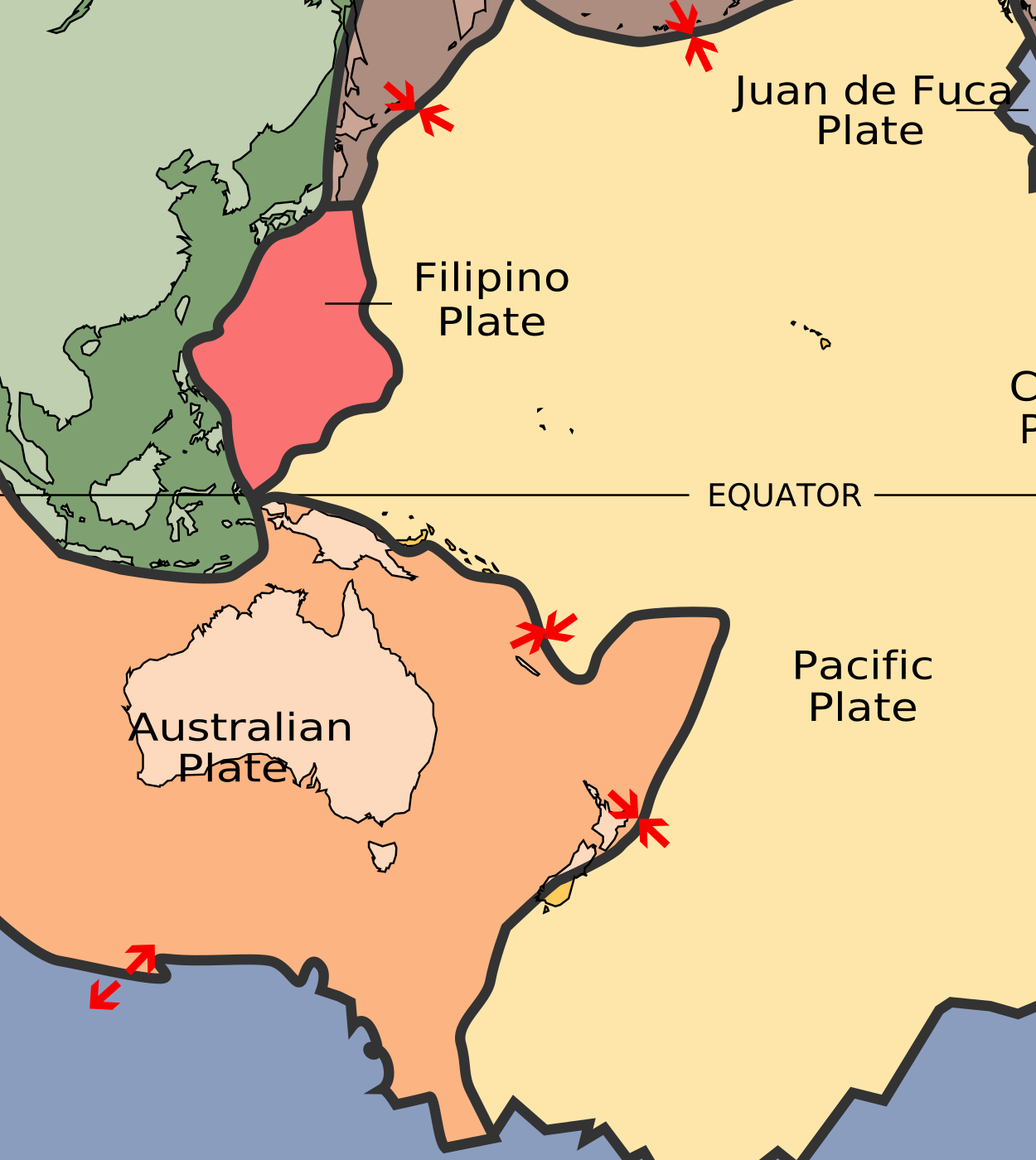
The Sunda Trench sits at the northern edge of your plate. Map: USGS (public domain).
You're standing on the Indo-Australian PlateThe piece of Earth's crust and upper mantle that Australia sits on. It includes Australia, India, and a large area of the surrounding ocean floor.. To the north, it meets the Eurasian PlateThe plate that includes most of Europe and Asia. It meets the Indo-Australian Plate just north of Indonesia. at the Sunda Trench. Before we work out what happens at this boundary, let's build the picture together.
What is a tectonic plate?
Earth has layers. The very outermost (the crust plus the rigid topmost part of the mantle) together forms a single hard shell called the lithosphere.
The lithosphere isn't continuous. It's broken into about fifteen giant pieces. Each piece is a tectonic plate. Plates sit on a softer layer of mantle below called the asthenosphere, which lets them slowly move. Australia sits on one of them.
What's underneath? (Hint: not lava.)
The mantle is the thick layer below the crust. It's hot (about 1000°C near the top, hotter deeper down), but heat doesn't always mean liquid.
The mantle is solid rock. It just flows incredibly slowly, like glacier ice creeping downhill over centuries. Lava (which you might see from a volcano) is molten rock, but the mantle itself, almost everywhere, is solid.
Why do plates move at all?
Heat from Earth's deep interior makes mantle rock circulate slowly. Hot rock rises, cools near the surface, sinks again, and the loop continues, like a slow-motion pot of soup.
This circulation drags the plates above with it. That's the engine. The Indo-Australian Plate is being carried north at about 7 centimetres per year, roughly the speed your fingernails grow.
Convergent boundaries
When two plates push toward each other, the denser one usually dives under. The diving plate descends into the asthenosphere, where its leading edge releases water that lowers the melting point of surrounding mantle rock. That magma rises and feeds volcanoes on the upper plate, while the deep depression where the plates meet forms an ocean trench.
This is what's happening right now at the Sunda Trench, north of Java. This is the boundary we'll examine in detail shortly.
Divergent boundaries
When two plates pull apart, magma from the asthenosphere rises into the widening gap. As it reaches the surface, it cools and hardens into new oceanic crust. The plates are continuously created at these boundaries, then carried outward.
Most divergent boundaries lie on the ocean floor as mid-ocean ridges. The Southeast Indian Ridge, the southern edge of the Indo-Australian Plate, is one such boundary, and it's why Australia is being carried steadily northward.
Transform boundaries
At transform boundaries, plates don't push toward or pull away from each other, they slide past each other sideways. No crust is created or destroyed. The two sides grind against each other along a fault line, and the friction builds stress that releases periodically as earthquakes.
Watch how features that were once continuous, a road, a river, become offset across the fault as the blocks move. New Zealand's Alpine Fault, the southeastern edge of the Indo-Australian Plate, is exactly this kind of boundary.
All three on one Earth
These three patterns aren't separate phenomena, they're all happening on the same Earth, all the time. The boundary between any two plates is one of these three types, and the same plate often has different boundary types on its different edges.
The Indo-Australian Plate is a perfect example. Its northern edge meets the Eurasian Plate at the Sunda Trench (convergent). Its southern edge spreads away from the Antarctic Plate at the Southeast Indian Ridge (divergent). Its southeastern edge grinds past the Pacific Plate at the Alpine Fault (transform). All four of these will become our case studies.
Now apply what you know.
Here's what's true at this specific boundary:
Take a moment. With what you now know about plates, mantle, and how plates can meet. What do you reckon happens here?
What do you think will happen at this boundary?
Choose an option above and write at least 5 characters of reasoning.
Watch what actually happens.
Now make sense of what you saw.
Write at least 15 characters to enable Submit (0/15).
The 2004 Boxing Day earthquake happened here.
On 26 December 2004, the Indo-Australian Plate slipped suddenly beneath the Eurasian Plate, displacing enormous amounts of seawater and generating a tsunami that reached coastlines from Indonesia to East Africa.
Over 230,000 people died. It is the deadliest tsunami in recorded history.
The plates have not stopped moving. The Indo-Australian Plate continues to push north at about seven centimetres a year. The next slip is a question of when, not whether.